


Page 57 - GALENIKA MEDICAL JOURNAL
P. 57
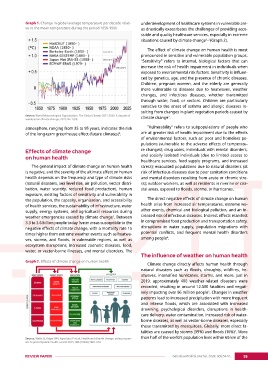
Graph 1. Change in global average temperature per decade relati-  underdevelopment of healthcare systems in vulnerable are-
            ve to the mean temperature during the period 1850-1900  as drastically exacerbates the challenges of providing acce-
                                                                ssible and quality healthcare services, especially in extreme
                                                                situations caused by climate change 1, 2  (Graph 2).

                                                                  The effect of climate change on human health is most
                                                                pronounced in sensitive and vulnerable population groups.
                                                                "Sensitivity"  refers  to  internal,  biological  factors  that  can
                                                                increase the risk of health impairment in individuals when
                                                                exposed to environmental risk factors. Sensitivity is influen-
                                                                ced by genetics, age, and the presence of chronic diseases.
                                                                Children,  pregnant  women,  and  the  elderly  are  generally
                                                                more  vulnerable  to  diseases  due  to  heatwaves,  weather
                                                                changes,  and  infectious  diseases,  whether  transmitted
                                                                through  water,  food,  or  vectors.  Children  are  particularly
                                                                sensitive to the onset of asthma and allergic diseases re-
                                                                sulting from changes in plant vegetation periods caused by
            Source: World Meteorological Ogranization. The Global Climate 2011-2020. A decade of   climate change .
                                                                            2
            acceleration climate change, 2023, No 1338.
            atmosphere, ranging from 35 to 95 years, indicates the risk   “Vulnerability“ refers to subpopulations of people who
            of the long-term greenhouse effect (future climates) .  are at greater risk of health impairment due to the effects
                                                      2
                                                                of environmental factors, such as: poor and homeless po-
                                                                pulations (vulnerable to the adverse effects of temperatu-
            Effects of climate change                           re changes); drug users, individuals with mental disorders,
            on human health                                     and  socially  isolated  individuals  (due  to  limited  access  to
                                                                healthcare services, food supply programs, and increased
               The general impact of climate change on human health   stress); evacuated populations due to natural disasters (at
            is negative, and the severity of the ultimate effect on human   risk of infectious diseases due to poor sanitation conditions
            health depends on the frequency and type of climate risks   and mental disorders resulting from acute or chronic stre-
            (natural disasters, sea level rise, air pollution, vector distri-  ss); outdoor workers, as well as residents in riverine or coa-
            bution,  water  scarcity,  reduced  food  production),  human   stal areas, exposed to floods, storms, or hurricanes.
            exposure, existing factors of sensitivity and vulnerability in
            the population, the capacity, organization, and accessibility   The direct negative effects of climate change on human
            of health services, the sustainability of infrastructure, water   health arise from increased air temperatures, extreme we-
            supply, energy systems, and agricultural resources during   ather events, chemical and biological pollution, and an in-
            weather emergencies caused by climate change . Between   creased risk of infectious diseases. Indirect effects manifest
                                                   1
            3.3 to 3.6 billion people today live in areas susceptible to the   in compromised food production and transportation safety,
            negative effects of climate change, with a mortality rate 15   disruptions  in  water  supply,  population  migrations  with
            times higher from extreme weather events such as heatwa-  potential  conflicts,  and  frequent  mental  health  disorders
                                                                           4
            ves,  storms,  and  floods,  in  vulnerable  regions,  as  well  as   among people .
            ecosystem disruptions, increased zoonotic diseases, food,
            water, or vector-borne illnesses, and mental disorders. The
                                                                The influence of weather on human health
            Graph 2. Effects of climate change on human health
                                                                  Climate change directly affects human health through
                                                                natural  disasters  such  as  floods,  droughts,  wildfires,  he-
                                                                atwaves, intensified hurricanes, storms, and more. Just in
                                                                2019,  approximately  400  weather-related  disasters  were
                                                                recorded, resulting in around 12.000 fatalities and negati-
                                                                vely impacting over 96 million people . Changes in weather
                                                                                              5
                                                                patterns lead to increased precipitation with more frequent
                                                                and  intense  floods,  which  are  associated  with  increased
                                                                drowning,  psychological  disorders,  disruptions  in  health-
                                                                care delivery, water contamination, increased risk of water-
                                                                borne diseases, as well as vector-borne diseases, especially
                                                                those transmitted by mosquitoes. Globally, most direct fa-
                                                                talities are caused by storms (39%) and floods (16%) . More
                                                                                                         5
            Source: Watts N, Adger WN, Agnolucci P et ak. Health and climate change: policy respon-  than half of the world's population lives within 60 km of the
            ses to protect public health. Lancet 2015; 386 (10006):1861-914.


            REVIEW PAPER                                                      Galenika Medical Journal, 2024; 3(9):54-61.  55

