


Page 62 - GALENIKA MEDICAL JOURNAL
P. 62
and training healthcare workers to react promptly to clima-  ecosystems, there is also a significant risk of extinction of
          te-related disasters.                              endemic species, which could increase by tenfold with war-
                                                             ming of 3°C;
             The  implementation  of  the  “One  Health“  approach  in-
          volves  studying  ecosystem  changes  in  vulnerable  areas,   Furthermore, there will be a continued reduction in wa-
          strengthening  early  detection  systems  for  zoonotic  dise-  ter availability (global glacier loss of 18 ± 13% will be associa-
          ases, preventing epidemics, improving agriculture and in-  ted with decreased water availability for agriculture, hydro-
          creasing  food  production,  constructing  safe  water  supply   power, and human use, along with reduced groundwater on
          and sanitation systems, as well as ensuring urban planning   islands  and  negative  impacts  on  freshwater  ecosystems),
          norms,  safe  transportation,  and  supply  of  clean  energy,   with extremely low and high streamflows occurring at the
          alongside adaptation to existing adverse climate factors.  same locations, and an increase in direct flood damages by
                                                             1.4-2 times at 2°C warming and by 2.5-3.9 times at 3°C war-
                                                             ming compared to the targeted warming of 1.5°C;
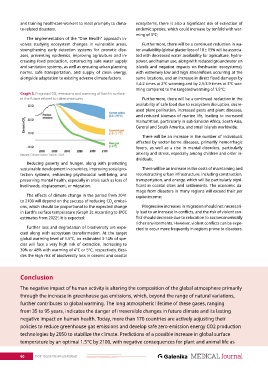
          Graph 3. Projected CO  emissions and warming of Earth's surface
                          2
          in the future related to taken measures               Furthermore, there will be a continued reduction in the
                                                             availability of safe food due to ecosystem disruption, decre-
                                                             ased plant pollination, increased pests and plant diseases,
                                                             and reduced biomass of marine life, leading to increased
                                                             malnutrition, particularly in sub-Saharan Africa, South Asia,
                                                             Central and South America, and small islands worldwide;

                                                                There will be an increase in the number of individuals
                                                             affected  by  vector-borne  diseases,  primarily  hemorrhagic
                                                             fevers,  as  well  as  a  rise  in  mental  disorders,  particularly
                                                             anxiety and stress, especially among children and older in-
          Source: Climate Action Tracker, 2023.
                                                             dividuals;
             Reducing  poverty  and  hunger,  along  with  promoting
          sustainable development in countries, improving social pro-  There will be an increase in the costs of maintaining and
          tection  systems,  enhancing  psychosocial  well-being,  and   reconstructing urban infrastructure, including construction,
          preserving mental health, especially in crisis such as loss of   transportation, and energy, which will be particularly signi-
          livelihoods, displacement, or migration.           ficant in coastal cities and settlements. The economic da-
                                                             mage from disasters in many regions will exceed their per
             The effects of climate change in the period from 2041   capita income;
          to 2100 will depend on the success of reducing CO  emissi-
                                                   2
          ons, which should be proportional to the expected change   Progressive increases in migration should not necessari-
          in Earth's surface temperature (Graph 3). According to IPCC   ly lead to an increase in conflicts, and the risk of violent con-
          estimates from 2022 , it is expected:              flict should decrease due to relocation to socioeconomically
                          2
                                                             richer environments. However, violent conflicts can be expe-
             Further loss and degradation of biodiversity are expe-  cted to occur more frequently in regions prone to disasters.
          cted  along  with  ecosystem  transformation.  At  the  target
          global warming level of 1.5°C, an estimated 3-14% of spe-
          cies  will  face  a  very  high  risk  of  extinction,  increasing  to
          39% or 48% with warming of 4°C or 5°C, respectively. Besi-
          des the high risk of biodiversity loss in oceanic and coastal


          Conclusion

          The negative impact of human activity is altering the composition of the global atmosphere primarily
          through the increase in greenhouse gas emissions, which, beyond the range of natural variations,
          further contributes to global warming. The long atmospheric lifetime of these gases, ranging
          from 35 to 95 years, indicates the danger of irreversible changes in future climate and its lasting
          negative impact on human health. Today, more than 170 countries are actively adjusting their
          policies to reduce greenhouse gas emissions and develop safe zero-emission energy CO2 production

          technologies by 2050 to stabilize the climate. Predictions of a possible increase in global surface
          temperature by an optimal 1.5°C by 2100, with negative consequences for plant and animal life as


          60     DOI: 10.5937/Galmed2409062I

