


Page 47 - GALENIKA MEDICAL JOURNAL
P. 47
0.5 mg, can reduce cardiovascular events in individuals with   The SMART (Secondary Manifestation of ARTerial dise-
            poor risk factor control or recurrent events despite optimal   ase) model estimates the individual residual risk for recu-
            therapy .                                           rrent myocardial infarction, stroke, or vascular death (Table
                  8
                                                                2). The study included a cohort of patients in Utrecht, and
            Residual thrombotic risk                            Table 1. Clinical parameters necessary for calculating residual risk
                                                                using the EUROASPIRE model
                                                                                     8, 33, 34
               Acetylsalicylic  acid  is  indicated  for  all  patients  with  si-  Country - (Serbia is included in the calculator)
            gnificant coronary artery disease for lifelong use, in the ab-     Cardiovascular risk (1 or 2 years)
            sence of contraindications, at doses of 75-100 mg per day.                Age
            Dual antiplatelet therapy (aspirin + potent P2Y12 receptor
            inhibitor,  such  as  ticagrelor  or  prasugrel)  is  an  essential   Diabetes mellitus (DM and value HbA1c < 7%, DM and value HbA1c ≥ 7%)
            component of optimal medication therapy within the first       Previous CVI, HF, PAD, PCI, depression, anxiety
            year of acute coronary syndrome in the absence of contrain-           Non-HDL cholesterol
            dications. In specific clinical cases (assessment of ischemic/      Glomerular filtration (eGFR)
            thrombotic risk and bleeding risk, presence of comorbidi-  Legend: CVI - Cerebrovascular Insult; HF - Heart Failure; PAD - Peripheral Arterial
            ties  such  as  atrial  fibrillation  requiring  oral  anticoagulant   Disease; PCI - Percutaneous Coronary Intervention; DM - Diabetes Mellitus; HbA1C -
                                                                glycosylated hemoglobin or hemoglobin A1c.
            therapy), antiplatelet therapy may be shortened (< 12 mon-
            ths), extended (> 12 months), or modified .         the results obtained were validated in several external clini-
                                             4, 8
                                                                cal studies. However, the model included patients enrolled
                                                                before 2010 who were followed for 4.7 years, so it could not
            Do models for estimating the residual               reliably be applied to assess the ten-year risk. Additionally,
            risks contribute to better clinical practice?       it did not include parameters related to regional differences
                                                                in CVD incidence, as well as other diseases that may lead to
               To define individual risk more closely within a universally   fatal outcomes unrelated to CVD.
            defined group of patients with very high cardiovascular risk,
            several  risk  assessment  models  have  been  formulated.   The SMART 2 model was developed by enhancing the
            These models are based on easily “measurable“ clinical cha-  mentioned parameters and included 377.399 patients with
            racteristics of patients. Identifying patients with high and   coronary, cerebral, and peripheral atherosclerosis aged 40
            very high risk provides clinical guidance for the necessity of   to 80 years, with 64.513 new events 35-37 . It is formulated in
            implementing more intensive treatment and interventions   such a way that using an online calculator, the residual risk
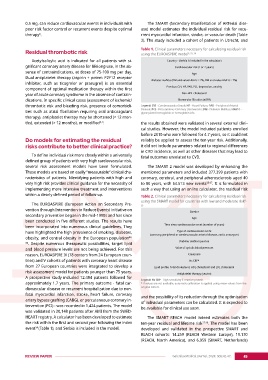
            within a clearly defined period of follow-up.       Table 2. Clinical parameters necessary for calculating residual risk
                                                                using the SMART model for countries with low and moderate risk 8,
               The  EUROASPIRE  (European  Action  on  Secondary  Pre-  35
            vention through Intervention to Reduce Events) initiative on             Gender
            secondary prevention began in the mid-1990s and has since
            been conducted in five different studies. The results have                Age
            been incorporated into numerous clinical guidelines. They     Time since cardiovascular event (number of years)
                                                                                Type of cardiovascular event
            have highlighted the high prevalence of smoking, diabetes,   (coronary, peripheral or cerebrovascular arterial disease, aortic aneurysm)
            obesity, and central obesity in the European population 33,
            34 . Despite numerous therapeutic possibilities, target lipid        Diabetes mellitus (yes/no)
            and blood pressure levels are not being achieved. For this         Value of systolic blood pressure
            reason, EUROASPIRE IV (78 centers from 24 European coun-                 Creatinine
            tries) and V cohorts of patients with coronary heart disease             Hs CRP*
            from 27 European countries were integrated to develop a   Lipid profile: Total cholesterol, HDL cholesterol and LDL cholesterol
            risk assessment model for patients younger than 75 years.           Antiplatelet therapy (yes/no)
            A prospective study included 12.484 patients followed for   Legend: Hs CRP - High-sensitivity C-reactive protein.
            approximately 1.7 years. The primary outcome - fatal car-  * if values are not available, automatic calibration is applied using mean values from the
            diovascular disease or recurrent hospitalization due to non-  original cohort.
            fatal  myocardial  infarction,  stroke,  heart  failure,  coronary   and the possibility of its reduction through the optimization
            artery bypass grafting (CABG), or percutaneous coronary in-  of individual parameters can be calculated. It is expected to
            tervention (PCI) - was recorded in 1,424 patients. The model   be available for clinical use soon.
            was validated in 20,148 patients after AMI from the SWED-
            HEART registry. A calculator has been developed to estimate   The  SMART  REACH  model  indeed  estimates  both  the
            the risk within the first and second year following the index   ten-year residual and lifetime risk 37-39 . The model has been
            event (Table 1), and Serbia is included in the model.  developed  and  validated  in  the  prospective  SMART  and
                 34
                                                                REACH  cohorts:  14.259  (REACH  Western  Europe),  19.170
                                                                (REACH,  North  America),  and  6.959  (SMART,  Netherlands)


            REVIEW PAPER                                                      Galenika Medical Journal, 2024; 3(9):42-47.  45

