


Page 73 - GALENIKA MEDICAL JOURNAL
P. 73
and  recommendations  to  ensure  a  safe  environment  for   important laboratory parameter than blood glucose levels
            these  patients  in  dental  practices.  The  focus  of  dentists   because blood glucose levels fluctuate throughout the day
            when performing interventions in these patients still lies on   (depending on the time of day, meals, stress...) .
                                                                                                     1-3
            the potential occurrence of hypo- and hyperglycemia, their
            prevention, and appropriate management .              Preprocedural  preparation  of  patients  with  diabetes
                                              26
                                                                mellitus  for  dental  procedures  certainly  includes  evaluati-
                                                                on of diabetes complications (acute and chronic) and other
            Evaluation and preparation of patients              comorbidities that may not necessarily be related to diabe-
            with diabetes before dental interventions           tes mellitus. However, it is important to keep in mind that
                                                                among other comorbidities, hypertension is present in 40-
               From a dental perspective, the most important elements   50% of diabetics and may be associated with atherosclero-
            of pre-procedural evaluation of patients with diabetes melli-  sis, while approximately 17% of patients with diabetes have
            tus (DM) include: assessing the duration of the disease and   occult infections. Coronary artery disease is often present,
            treatment regimen, the presence of DM complications and/  especially in young individuals (which is atypical), as well as
            or other comorbidities, and reviewing laboratory tests (blo-  congestive heart failure, hepatic steatosis, and others .
                                                                                                          2
            od glucose levels, glycosylated hemoglobin, and other nece-
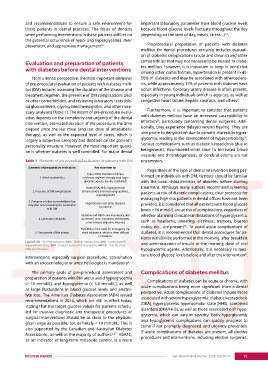
            ssary analyses) (Table 1). The extent of pre-procedural evalu-  Furthermore,  it  is  important  to  consider  that  patients
            ation depends on the complexity and urgency of the dental   with  diabetes  mellitus  have  an  increased  susceptibility  to
                                                                       28
            intervention, estimated duration of the procedure, the time   infection ,  particularly  concerning  dental  surgeries.  Addi-
            elapsed  since  the  last  meal  (and  last  dose  of  antidiabetic   tionally, they experience delayed wound healing. They are
            therapy),  as  well  as  the  expected  level  of  stress,  which  is   also prone to dehydration due to osmotic diuresis in hyper-
                                                                                                             26
            largely a subjective category and depends on the patient's   glycemia, leading to the development of hyperosmolality .
            personality structure. However, the most important questi-  Serious complications such as diabetic ketoacidosis (due to
            on is whether diabetes is well controlled. For major dental   ketogenesis),  thromboembolism  (due  to  increased  blood
                                                                viscosity and thrombogenesis), or cerebral edema are not
            Table 1. Elements of pre-procedural evaluation of patients with DM  uncommon.
              Elements of preoperative evaluation  Pay attention to:
                                                                  Regardless of the type of dental intervention being per-
                                        Type of DM; Duration of illness   formed on individuals with DM, dentists should be familiar
                   1. DM characteristics  Treatment regimen-therapy (oral hypo-
                                      glycemic agents, insulin, combined)  with  the  basic  characteristics  of  diabetes  before  starting
                                       Acute (DKA, HHS, hypoglycemia)   treatment. Although many authors recommend screening
                2. Presence of DM complications  Chronic (micro and macroangiopathies,   patients at risk of diabetic complications, clear protocols for
                                            especially DAN)
                                                                managing high-risk patients in dental offices have not been
              3. Presence of other comorbidities that   Hypertension and other diseases
              may (but not necessarily) be associated   CV, NAFLD  provided. It is considered that all patients with blood glucose
                      with DM                                   levels > 16 mmol/L are at risk of complications, regardless of
                                     Glycemia and HbA1c are mandatory, and   whether alarming clinical manifestations of hyperglycemia,
                  4. Laboratory analyses  as needed: urea, creatinine, electrolytes,   such  as  headache,  sweating,  dizziness,  tremors,  blurred
                                       urine analysis (albumin, ketones)
                                                                vision, etc., are present . To avoid acute complications of
                                                                                   26
                                     Possibility of the need for emergency tra-
                 5. Assessment of the airway  cheal intubation, which is often difficult   diabetes, it is recommended that dental procedures for pa-
                                             in diabetics
                                                                tients with DM be performed in the morning, after breakfast
            Legend: OH - Oral Hypoglycemic; DKA - Diabetic Ketoacidosis; HHS - Hyperglycemic   and administration of insulin or the morning dose of oral
            Hyperosmolar State; DAN - Diabetic Autonomic Neuropathy; NAFLD - Non-Alcoholic
            Fatty Liver Disease.                                hypoglycemic agents. Additionally, it is necessary to mea-
                                                                sure blood glucose levels before and after the intervention .
                                                                                                              8
            interventions, especially surgical procedures, consultation
            with an endocrinologist or anesthesiologist is mandatory .
                                                          2
               The  primary  goals  of  pre-procedural  assessment  and   Complications of diabetes mellitus
            preparation of patients with DM are to avoid hyperglycemia
                                                                  Complications of diabetes can be acute or chronic, with
            (>  10  mmol/L),  and  hypoglycemia  (<  3.8  mmol/L),  as  well   acute complications being more significant from a dental
            as  large  fluctuations  in  blood  glucose  levels  and  electro-
            lyte loss. The American Diabetes Association (ADA) issued   perspective. Acute complications of diabetes include those
                                                                associated with severe hyperglycemia: diabetic ketoacidosis
            recommendations  in  2014,  which  are  still  in  effect  today,
            stating that the target glucose values for patients schedu-  (DKA), hyperglycemic hyperosmolar state (HHS), combined
                                                                disorders (DKA/HHS), as well as those associated with hypo-
            led for invasive diagnostic and therapeutic procedures or
            surgical interventions should be as close to the physiolo-  glycemia,  which  can  vary  in  severity.  Both  hyperglycemic
                                                                and  hypoglycemic  complications  can  quickly  progress  to
            gical range as possible, but definitely < 10 mmol/L. This is
            also  supported  by  the  Canadian  and  Australian  Diabetes   coma  if  not  promptly  diagnosed  and  urgently  prevented.
                                                                If acute complications of diabetes are present, all elective
            Associations, as well as the majority of authors 2, 27 . HbA1C,
            as  an indicator  of  long-term metabolic control, is  a more   procedures and interventions, including elective surgeries,


            REVIEW PAPER                                                      Galenika Medical Journal, 2024; 3(9):69-75.  71

