


Page 22 - GALENIKA MEDICAL JOURNAL
P. 22
of the pituitary and hypothalamus can be associated with   unchanged throughout the day, but its level varies depen-
          disruptions in brain and eye function and anatomy . Acqu-  ding on age and gender.
                                                   5
          ired GHD is most commonly a result of pituitary and hypo-
          thalamic tumors (non-functioning pituitary adenomas, cra-
          niopharyngiomas, germinomas, Cushing's disease), cranial   Diagnosis of adult growth
          irradiation, head injuries, brain infections, vascular anoma-  hormone deficiency (AGHD)
          lies, and perinatal trauma. In cases where the cause of GHD
          is  unknown,  with  a  normal  magnetic  resonance  imaging   Clinical diagnosis of AGHD
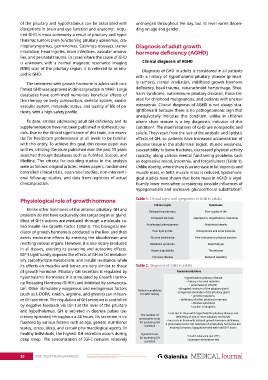
          (MRI) scan of the pituitary region, it is referred to as idio-  Diagnosis of GHD in adults is considered in all patients
          pathic GHD.
                                                             with  a  history  of  hypothalamic-pituitary  disease  (primari-
             The treatment with growth hormone in adults with con-  ly tumors), cranial irradiation, childhood growth hormone
          firmed GHD was approved in clinical practice in 1996 . Large   deficiency, head trauma, subarachnoid hemorrhage, Shee-
                                                   6
          databases  have  confirmed  numerous  beneficial  effects  of   han's syndrome, autoimmune pituitary diseases, those tre-
          this therapy on body composition, skeletal system, cardio-  ated for childhood malignancies, and patients with unclear
          vascular system, metabolic status, and quality of life of pa-  osteopenia. Clinical diagnosis of AGHD is not always stra-
          tients, with a high safety profile.                ightforward because there is no pathognomonic sign that
                                                             unequivocally  indicates  this  condition,  unlike  in  children
             To date, articles addressing adult GH deficiency and its   where  short  stature  is  a  key  diagnostic  indicator  of  this
          supplementation have not been published in domestic jour-  condition . The manifestations of GHD are nonspecific and
                                                                     8
          nals. Due to the clinical significance of this topic, it is essen-  subtle. They result from the lack of the anabolic and lipolytic
          tial for healthcare professionals at all levels to be familiar   effects of GH, so patients have increased accumulation of
          with this entity. To achieve this goal, this review paper was   adipose tissue in the abdominal region, muscle weakness,
          written, utilizing literature published over the past 15 years   susceptibility to bone fractures, decreased physical activity
          searched through databases such as PubMed, Scopus, and   capacity, along various mental functioning problems such
          Medline.  The  criteria  for  including  studies  in  the  analysis   as depressive mood, insomnia, and forgetfulness (Table 1).
          were as follows: original articles, review papers, randomized   Unlike obesity, where there is an increase in fat deposits and
          controlled clinical trials, open-label studies, non-interventi-  muscle mass, in GHD, muscle mass is reduced. Epidemiolo-
          onal  follow-up  studies,  and  data  from  registries  of  actual   gical studies have shown that bone mass in AGHD is signi-
          clinical practice.                                 ficantly lower even when considering possible influences of
                                                             hypogonadism  and  excessive  glucocorticoid  substitution .
                                                                                                            9
          Physiological role of growth hormone               Table 1. Clinical signs and symptoms of GHD in adults
                                                                     Clinical signs           Symptoms
             Unlike other hormones of the anterior pituitary, GH and   Reduced muscle mass  Poor quality of life
          prolactin do not have exclusively one target organ or gland.
          Most of GH's actions are mediated through a molecule ca-  Increased fat mass  (depression, forgetfulness, insomnia)
          lled Insulin-like Growth Factor I (IGF-I). This biological me-  Accelerated atherogenesis  Abdominal obesity
          diator of growth hormone is produced in the liver and then   Poor lipid profile  Osteoporosis and bone fractures
          exerts endocrine effects by entering the bloodstream and   Glucose intolerance  Poor tolerance to physical exertion
          reaching various organs. However, it is also locally produced   Metabolic syndrome  Rapid fatigue
          in all tissues, exerting its paracrine and autocrine effects.   Hypercoagulability  Thromboses
          IGF-I significantly opposes the effects of GH on fat metaboli-  Coronary disease  Reduced sweating
          sm, carbohydrate metabolism, and insulin resistance, while
          its effects on muscles and bones are very similar to those   Table 2. Diagnosis of GHD in adults
          of growth hormone. Pituitary GH secretion is regulated by             Recommendations
          hypothalamic hormones: it is stimulated by Growth Hormo-                 • hypothalamic-pituitary disease
          ne Releasing Hormone (GHRH) and inhibited by somatosta-                   • history of cranial radiation
                                                                                     • anamnesis of COGHD
          tin . Other stimulatory exogenous and endogenous factors   Patients-candidates   • disrupted structure of the pituitary gland
            7
          (such as L-DOPA, kinidin, arginine, and ghrelin) can influen-  for GHD testing  • congenital anomalies of the pituitary gland
                                                                                      • genetic mutations
          ce GH secretion. The regulation of GH secretion is controlled          • deficiency of other pituitary hormones
          by negative feedback via IGF-I at the level of the pituitary                • Sheehan syndrome
                                                                                      • unclear osteopenia
          and  hypothalamus.  GH  is  secreted  in  discrete  pulses  (se-  • one test in those with hypothalamic-pituitary disease and
                                                                The number of
          cretory episodes) throughout a 24 hours. Its secretion is in-  provocative tests   deficiency of one or more pituitary hormones
                                                                           • two tests in those with isolated growth hormone deficiency.
          fluenced by various factors such as age, gender, nutritional   for assessing GH   A provocative test is not necessary if all pituitary hormones are
          status, stress, sleep, and certain pharmacological agents. In   secretion  missing (complete hypopituitarism) with low IGF-I levels
          healthy individuals, the highest GH secretion occurs during   Dynamic tests   • insulin tolerance test (ITT)
          deep  sleep.  The  concentration  of  IGF-I  remains  relatively   for assessing GH   • glucagon stimulation test
                                                                 secretion

          20     DOI: 10.5937/Galmed2409023D

