


Page 16 - GALENIKA MEDICAL JOURNAL
P. 16
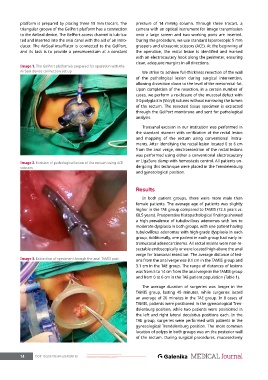
platform is prepared by placing three 10 mm trocars. The   pressure  of  14  mmHg  column.  Through  three  trocars,  a
          triangular groove of the GelPort platform has a connection   camera with an optical instrument for image transmission
          to the AirSeal device. The GelPort access channel is lubrica-  onto  a  large  screen  and  two  working  ports  are  inserted.
          ted and inserted into the anal canal with the aid of an intro-  During the procedure, we use standard laparoscopic 5 mm
          ducer. The AirSeal insufflator is connected to the GelPort,   graspers and ultrasonic scissors (ACE). At the beginning of
          and  its  task  is  to  provide  a  pneumorectum  at  a  constant   the  operation,  the  rectal  lesion  is  identified  and  marked
                                                             with an electrocautery hook along the perimeter, ensuring
                                                             clean, adequate margins in all directions.
          Image 1. The GelPort platform is prepared for operation with the
          AirSeal device connection set up                      We strive to achieve full-thickness resection of the wall
                                                             of  the  pathological  lesion  during  surgical  intervention,
                                                             allowing dissection down to the level of the mesorectal fat.
                                                             Upon completion of the resection, in a certain number of
                                                             cases, we perform a re-closure of the mucosal defect with
                                                             3-0 polyglactin (Vicryl) sutures without narrowing the lumen
                                                             of  the  rectum.  The  resected  tissue  specimen  is  extracted
                                                             through the GelPort membrane and sent for pathological
                                                             analysis.
                                                                Transanal excision in our institution was performed in
                                                             the standard manner with verification of the rectal lesion
                                                             and  mapping  of  the  rectum  using  conventional  instru-
                                                             ments. After identifying the rectal lesion located 0 to 6 cm
                                                             from the anal verge, electroresection of the rectal lesions
                                                             was performed using either a conventional electrocautery
                                                             or LigaSure clamp with hemostasis control. All patients un-
          Image 2. Excision of pathological lesion of the rectum using ACE
          scissors                                           dergoing this technique were placed in the Trendelenburg
                                                             and gynecological position.


                                                             Results
                                                                In  both  patient  groups,  there  were  more  male  than
                                                             female patients. The average age of patients was slightly
                                                             higher in the TAE group compared to TAMIS (72.5 years vs.
                                                             68.5 years). Preoperative histopathological findings showed
                                                             a  high  prevalence  of  tubulovillous  adenomas  with  low  to
                                                             moderate dysplasia in both groups, with one patient having
                                                             tubulovillous adenomas with high-grade dysplasia in each
                                                             group. Additionally, one patient in each group had early in-
                                                             tramucosal adenocarcinoma. All rectal lesions were non-re-
                                                             sectable endoscopically or were located high above the anal
                                                             verge for transanal resection. The average distance of lesi-
          Image 3. Extraction of specimen through the anal TAMIS port  ons from the anal verge was 8.1 cm in the TAMIS group and
                                                             3.1 cm in the TAE group. The range of distances of lesions
                                                             was from 5 to 14 cm from the anal verge in the TAMIS group
                                                             and from 0 to 6 cm in the TAE patient population (Table 1).

                                                                The  average  duration  of  surgeries  was  longer  in  the
                                                             TAMIS  group,  lasting  45  minutes,  while  surgeries  lasted
                                                             an average of 20 minutes in the TAE group. In 8 cases of
                                                             TAMIS, patients were positioned in the gynecological Tren-
                                                             delenburg position, while two patients were positioned in
                                                             the  left  and  right  lateral  decubitus  positions  each.  In  the
                                                             TAE group, surgeries were performed with patients in the
                                                             gynecological  Trendelenburg  position.  The  most  common
                                                             location of polyps in both groups was on the posterior wall
                                                             of  the  rectum.  During  surgical  procedures,  mucosectomy


          14     DOI: 10.5937/Galmed2409015S

